
Podcast Clips That Grow Your Audience Faster
Discover podcast clips that boost reach, grow your audience, and turn one episode into many assets faster with Clipo AI today.
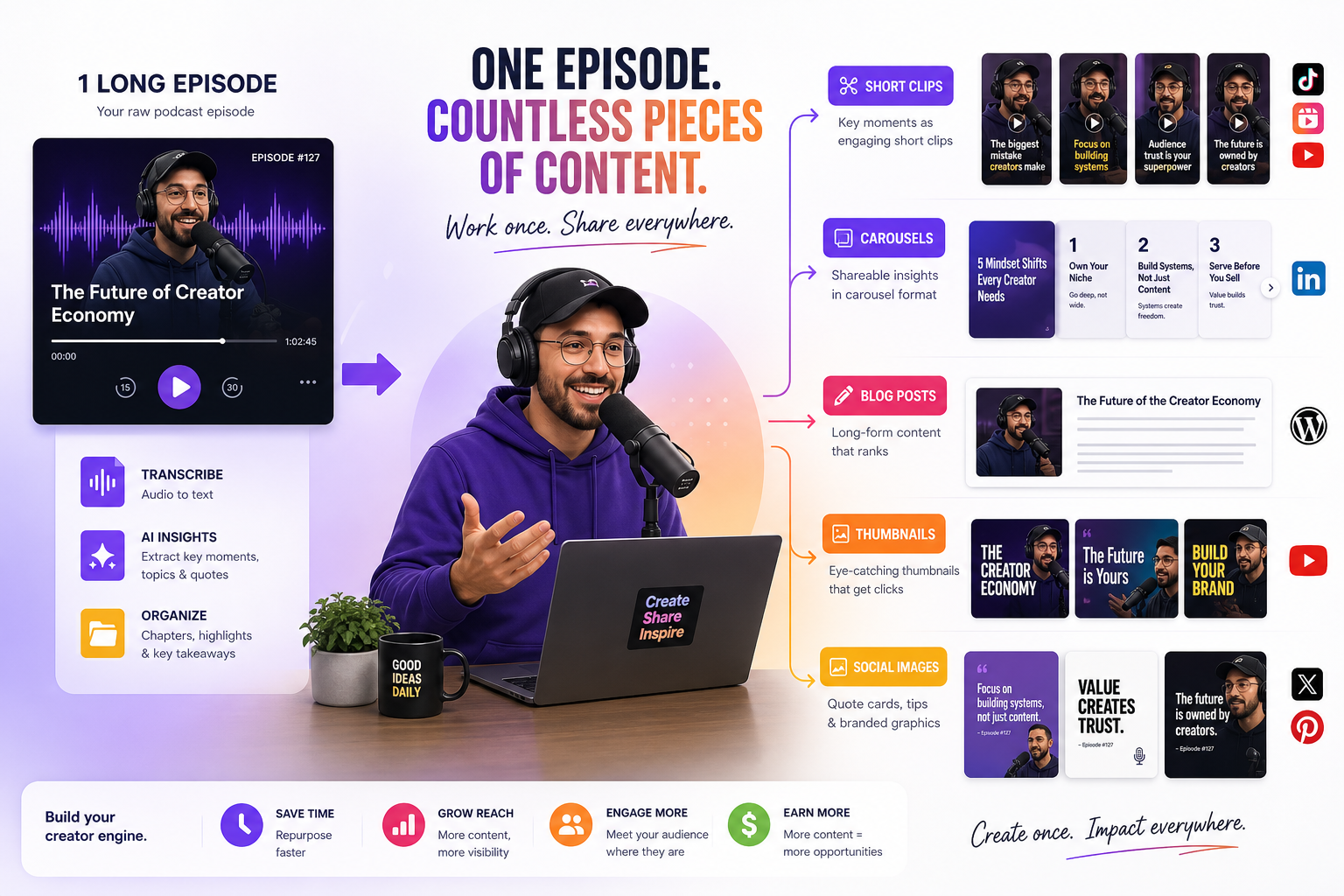
If you publish great episodes but still feel invisible, you do not have a content problem. You have a distribution problem.
That is exactly why podcast clips matter. They let you turn one long episode into short, high-impact assets built for discovery on TikTok, Instagram Reels, YouTube Shorts, LinkedIn, X, newsletters, blogs, and more. Instead of waiting for someone to commit to a 45-minute episode, you give them a fast, memorable reason to care in under a minute.
For podcasters, YouTubers, marketers, social teams, startups, and brands, this is one of the highest-leverage growth plays available right now. The real win is not just making clips. It is building a repeatable system that transforms every recording into a full content engine.
What Are Podcast Clips?
Podcast clips are short audio or video excerpts pulled from a full episode and repackaged for faster consumption.
The best podcast clips are not random highlights. They are deliberate, standalone moments that do at least one of these things:
- Spark curiosity
- Deliver a fast insight
- Trigger emotion
- Create surprise
- Start a conversation
- Make the viewer want the full episode
A strong clip can be:
- A 20–60 second vertical short
- A 2–5 minute insight cut for YouTube or LinkedIn
- A quote card
- A carousel summary
- A blog snippet
- A thumbnail-driven teaser
- A faceless short with captions and visuals
This is where most creators think too small. They assume "podcast clips" means only social video. In reality, clips are the entry point to a much larger repurposing system.
Why Podcast Clips Matter More Than Ever
The modern audience discovers creators in fragments first, not in full episodes.
People rarely wake up thinking, "I want to try a totally new 90-minute podcast today." But they will absolutely stop for a sharp take, an unexpected story, or a practical insight that lands fast in-feed.
"Approximately 95% of consumers watch short-form videos regularly, with 71% engaging daily." — Source
That is the opportunity. Podcast clips let you meet audiences in the format they already prefer.
The Core Benefits of Podcast Clips
| Benefit | Why It Matters |
|---|---|
| Faster discovery | Short clips give algorithms more chances to test your content with new audiences |
| More reach from every episode | One recording becomes many assets instead of one upload |
| Better conversion | Clips create curiosity that drives listeners to the full episode |
| More consistency | You can publish all week from a single session |
| Lower content cost | Repurposing reduces the need for constant net-new creation |
| Stronger brand recall | Repeated exposure builds familiarity and trust |
What Competitor Articles Get Right — and What They Miss
Most ranking articles on podcast clips repeat the same surface-level advice:
- Use short-form video
- Keep clips brief
- Add captions
- Post on social media
- Look for funny or controversial moments
That advice is not wrong. It is just incomplete.
The Real Content Gaps
Here is what most competitor content glosses over:
- They focus on clips as a tactic, not a system.
Real growth comes from turning each episode into a multi-asset workflow. - They barely discuss channel-specific packaging.
A clip for TikTok should not be treated exactly like a clip for LinkedIn or YouTube Shorts. - They ignore asset expansion beyond video.
Podcast clips can become carousels, blog posts, thumbnails, email content, summaries, and images. - They underplay speed and workflow.
The biggest failure point is not creativity. It is operational friction. - They do not solve tool sprawl.
Most creators juggle separate apps for clipping, editing, writing, image generation, scheduling, and publishing.
This is where Clipo AI has a real strategic advantage. Instead of forcing creators to assemble a patchwork stack, Clipo AI turns one recording into up to 20 content assets quickly in one platform. It combines clipping, editing, writing, thumbnails, carousels, images, and scheduling, while still giving you manual control when you want it.
What Makes a Podcast Clip Actually Work?
A clip works when it delivers value fast and still creates a reason to keep watching.
The 3-Part Structure of High-Performing Podcast Clips
1. The Hook
The first 1–3 seconds must interrupt the scroll.
Good hooks usually sound like:
- "Nobody tells creators this part..."
- "This is why most podcasts never grow."
- "We tested 100 clips and found something weird."
- "If you want more listeners, stop promoting your podcast like this."
2. The Tension
The middle keeps attention alive. This can be:
- A story
- A surprising stat
- A bold opinion
- A practical framework
- A revealing mistake
3. The Payoff
End with the answer, insight, twist, or takeaway.
The biggest mistake is giving the payoff too early or dragging too long to get there.
The Ideal Length for Podcast Clips
There is no one perfect duration for every platform, but there are smart ranges.
| Clip Type | Best Use | Suggested Length |
|---|---|---|
| Short-form discovery clip | Reels, Shorts, TikTok | 20–60 seconds |
| Mid-length insight clip | LinkedIn, X, YouTube, landing pages | 1–3 minutes |
| Deep-dive segment | YouTube, website, newsletter embed | 3–10 minutes |
Shorter is not always better. Clearer is better. A 45-second clip with a clean narrative beats a chaotic 15-second clip every time.
The Best Types of Podcast Clips for Audience Growth
Not every great podcast moment becomes a great social asset. The best clips usually fall into a few repeatable categories.
1. Contrarian Takes
These challenge common advice and stop the scroll fast.
Example: "Posting more content is not your growth problem. Packaging is."
2. Tactical Tips
These are actionable and save the viewer time or effort.
Example: "The easiest way to find a viral clip is to look for the sentence that would still make sense without the rest of the episode."
3. Emotional Stories
Stories outperform because they create retention.
Example: A founder sharing the exact moment they realized their content strategy was broken.
4. Surprising Facts
These create instant curiosity when backed by context.
5. Relatable Pain Points
These are powerful because audiences feel seen.
Example: "You spent 3 hours recording and now you need 8 more tools just to publish."
6. Fast Frameworks
Lists, formulas, and step-by-step insights are easy to consume and reshare.
The Non-Negotiables: Captions, Framing, and Packaging
It is not enough to clip a good moment. You need to package it for how people actually consume content.
"Approximately 85% of Facebook videos are watched on mute." — Source
Captions
Captions are essential for:
- Silent viewing
- Accessibility
- Higher retention
- Better comprehension
- Stronger hook emphasis
Vertical Framing
For Shorts, Reels, and TikTok, 9:16 is the default.
On-Screen Design
Use:
- Bold readable captions
- Fast pacing
- Clean cuts
- Strong first frame
- Brand consistency without clutter
Thumbnail Thinking
Even for short clips, packaging matters. The title line, cover frame, and opening seconds all shape click-through.
A Smarter Podcast Clip Workflow
Most creators lose momentum because the process is messy:
- Record episode
- Export file
- Upload to transcription tool
- Search manually for highlights
- Clip in another editor
- Add captions in another app
- Design thumbnail elsewhere
- Write caption copy separately
- Schedule in another tool
- Repeat until burned out
That is exactly the kind of workflow that kills consistency.
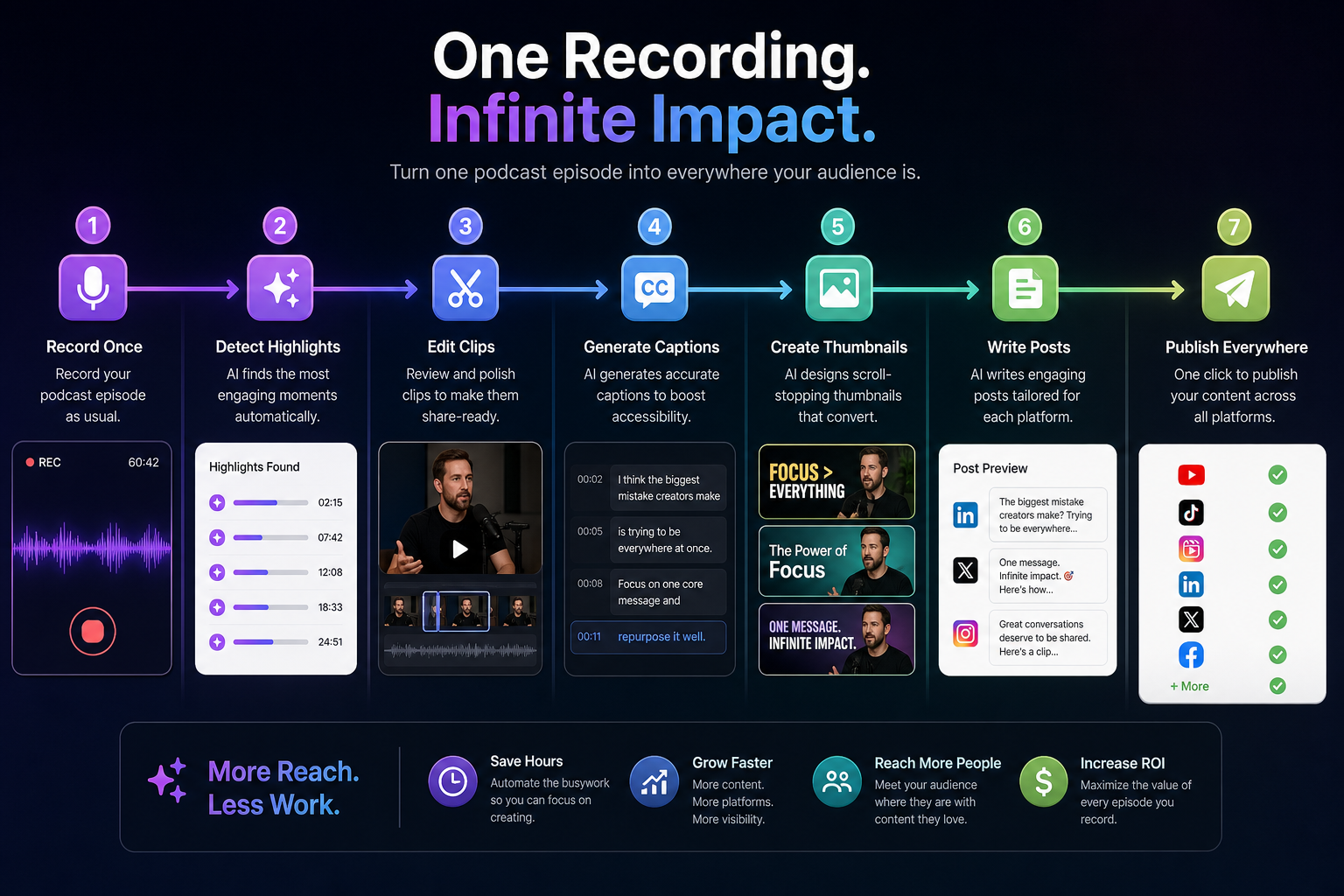
What an Efficient Workflow Looks Like
A high-performance workflow should let you:
- Upload one long-form recording
- Detect high-potential moments automatically
- Search clips by keyword or visual moment
- Edit fast with manual override
- Generate subtitles and style them
- Create thumbnails and images
- Write platform-specific captions and posts
- Build carousels and blog assets
- Publish across channels from one place
That is the shift from "making clips" to building a content operating system.
How Clipo AI Changes the Economics of Podcast Clips
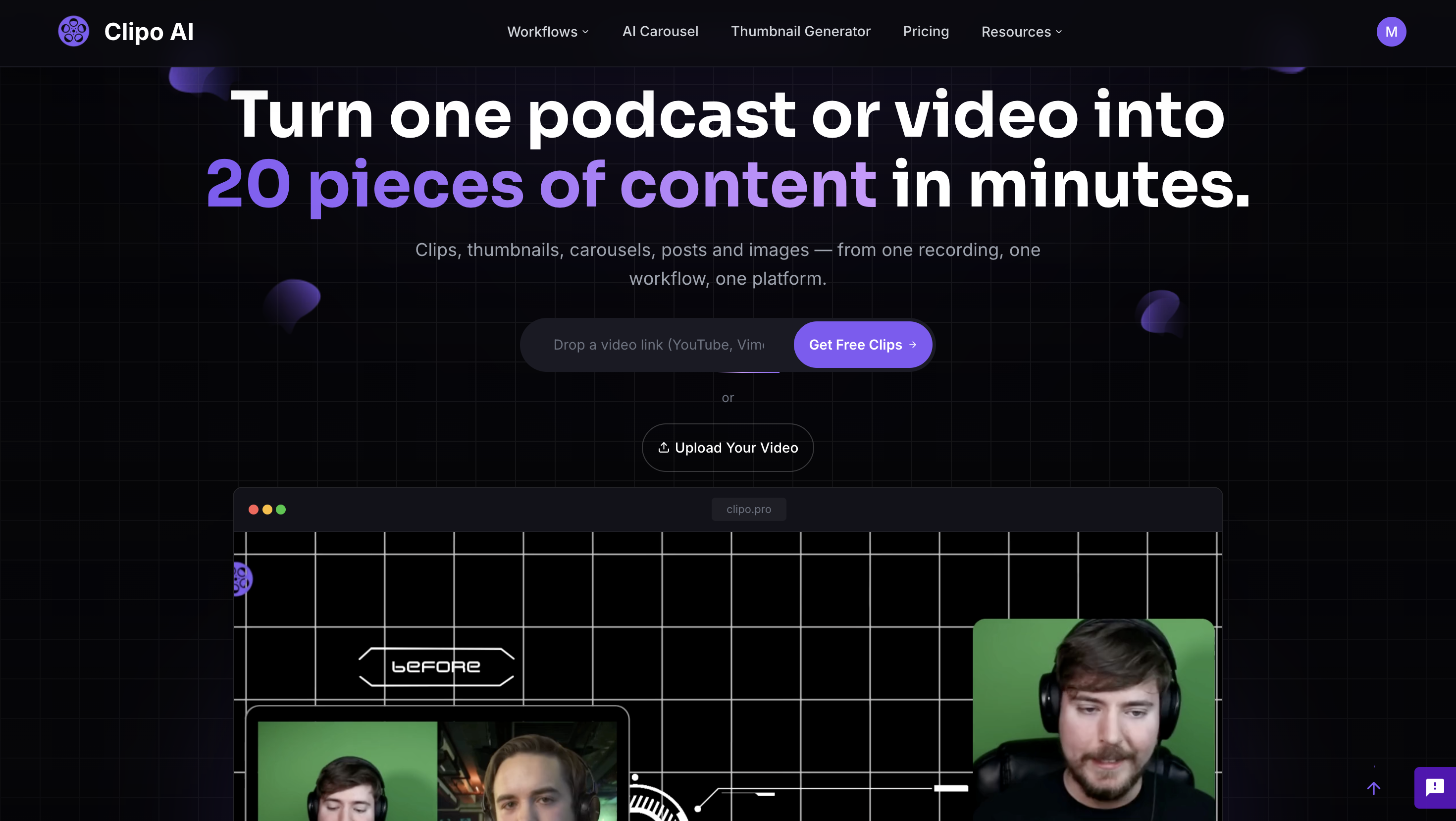
Clipo AI is not just a clipper. It is an all-in-one content engine for turning one recording into a full publishing workflow.
Why This Matters
Instead of paying for separate tools for:
- AI clipping
- Video editing
- Caption styling
- Thumbnail creation
- Writing
- Carousels
- Image generation
- Scheduling
- Publishing
Clipo AI combines them into one workflow.
Where Clipo AI Fits Naturally
Clipo AI helps creators and teams:
- Turn one recording into up to 20 content assets quickly
- Replace multiple subscriptions with one platform
- Save time with AI automation
- Keep manual creative control when precision matters
- Discover clip-worthy moments by keywords and visual cues
- Generate writing that matches the user's voice
- Publish across channels with an omni-channel workflow
- Produce more short-form content without increasing team overhead
This is especially valuable for podcasters, agencies, marketers, founders, and social media teams that need speed, consistency, and scale.
From One Podcast Episode to a Full Content Stack
A great episode should not produce one output. It should produce a stack.
Example Content Stack From One Recording
| Asset Type | Quantity | Purpose |
|---|---|---|
| Short-form podcast clips | 5–10 | Discovery and reach |
| Mid-length video cuts | 2–3 | Deeper engagement |
| Social captions | 5–10 | Platform-ready posting |
| Quote graphics | 3–5 | Shareability |
| Carousel post | 1–2 | Education and saves |
| Blog summary | 1 | Search traffic and authority |
| Newsletter intro | 1 | Email engagement |
| Thumbnails | Multiple | Better click-through |
| Still images / visuals | Multiple | Extra social assets |
This is the part most articles miss: the clip is not the end product. It is the source material for a full cross-channel campaign.
How to Find the Best Podcast Clips Fast
If you are manually scrubbing timelines from beginning to end, you are wasting time.
Look for These Signals
Strong standalone sentences
If a sentence makes sense even without the surrounding conversation, it may be clip-worthy.
Emotional spikes
Laughter, surprise, outrage, vulnerability, bold conviction.
Audience pain points
Moments that speak directly to a frustration or ambition.
Pattern interrupts
Anything unexpected, counterintuitive, or sharply phrased.
Clear transformations
Before/after stories, mistakes to avoid, specific wins.
Manual vs AI Discovery
| Method | Strength | Weakness |
|---|---|---|
| Manual review | High precision | Slow and tiring |
| Transcript search | Great for topic targeting | Misses visual and emotional moments |
| AI clip detection | Fast and scalable | Needs human review for best results |
| Keyword + visual detection | Best of both | Requires a platform built for it |
Clipo AI is strong here because it supports both automation and manual creative control. You can let AI surface the strongest moments, then refine with your own judgment.
Platform-by-Platform Optimization for Podcast Clips
A winning clip is not just good. It is native to the platform.
TikTok
Best for:
- Fast hooks
- Personality-driven clips
- Bold takes
- Emotional or surprising moments
Instagram Reels
Best for:
- Strong visuals
- Clean editing
- Tips, quotes, insights, and polished delivery
YouTube Shorts
Best for:
- Search-friendly topics
- Creator education
- Clips with clear titles and satisfying payoffs
Best for:
- B2B insights
- Founder/operator clips
- Marketing, leadership, team, and strategy content
X and Threads
Best for:
- Quote-led clips
- Sharp opinions
- Visual summaries
- Follow-up written threads
Your Website and Blog
Best for:
- Embedding clips in articles
- Improving dwell time
- Supporting SEO with richer media
Common Mistakes That Kill Clip Performance
Posting random highlights
A moment can be interesting in context and useless out of context.
Weak first frame
If the first second looks boring, the clip dies before it starts.
Over-editing
Too many zooms, sound effects, and flashy cuts can feel cheap and distracting.
Under-editing
If there is dead air, rambling, or messy setup, retention drops.
Using one clip format everywhere
Platform-native packaging matters.
No system
The real enemy is not lack of ideas. It is inconsistent execution.
Podcast Clips vs Audiograms: What Works Better Now?
Older articles often blur the line between all formats. Today, video-first podcast clips usually outperform traditional audiograms for reach.
Why? Because platforms reward visual engagement, human presence, and motion.
That said, audiogram-style or faceless formats can still work when:
- You only have audio
- The idea is strong enough to carry visually with text and motion
- You pair the audio with relevant images, b-roll, captions, and kinetic typography
Clipo AI supports both visual and faceless content workflows, which is important for audio-first teams that still need social-ready assets.
How Often Should You Post Podcast Clips?
A practical answer: more consistently than you think, but with less manual effort than you currently use.
For most creators, a strong rhythm looks like:
- 3–5 short clips per episode
- 1–2 quote or carousel posts
- 1 blog or newsletter summary
- 1 deeper video cut if the episode supports it
The goal is not to flood feeds. It is to build predictable distribution.
A Simple Weekly Podcast Clip System
Here is a practical model for one episode:
| Day | Asset |
|---|---|
| Day 1 | Full episode published |
| Day 2 | Short clip #1 |
| Day 3 | Carousel summary |
| Day 4 | Short clip #2 |
| Day 5 | Quote graphic or image post |
| Day 6 | Short clip #3 |
| Day 7 | Blog or newsletter recap |
When automated inside one system, this becomes dramatically easier to sustain.
Measuring Whether Your Podcast Clips Are Working
Do not judge clips only by vanity metrics.
Better Metrics to Track
- View retention
- Average watch time
- Saves and shares
- Profile visits
- Click-through to episode
- Subscriber or follower growth
- Full-episode plays after clip exposure
The purpose of a clip is not always to "go viral." Often, it is to build trust, increase repetition, and widen the top of funnel.
The Fastest Way to Scale Podcast Clips Without Burning Out
The creators and teams winning right now are not necessarily producing more original content. They are extracting more value from the content they already make.
That is the deeper lesson behind podcast clips.
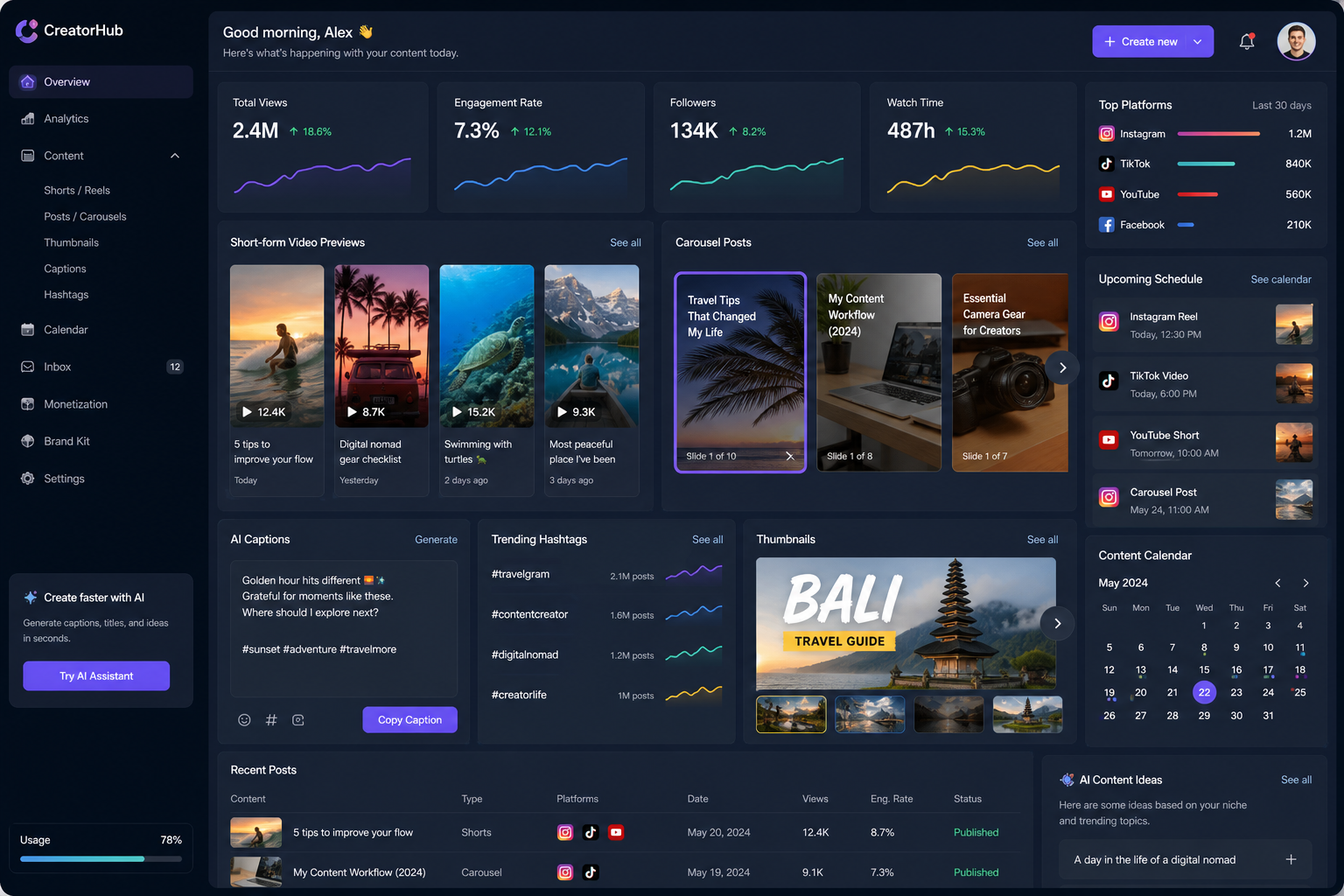
If one hour of recording can become:
- Shorts
- Reels
- YouTube assets
- Blogs
- Captions
- Carousels
- Images
- Thumbnails
- Scheduled posts
then your growth no longer depends on creating from scratch every day.
Final Verdict
Podcast clips are one of the fastest ways to grow your audience because they match how people discover content today: short, searchable, shareable, and platform-native.
But the real advantage is not just clipping. It is building a system that turns every recording into an asset pipeline.
That is why an all-in-one platform like Clipo AI is such a strong fit for modern creators and teams. Instead of managing a tangled stack of tools, you can turn one recording into up to 20 content assets quickly, automate the heavy lifting, keep creative control, reduce software costs, and publish everywhere from one workflow.
Ready to turn every episode into a full content engine?
Try Clipo AI FreeFAQ
How to make podcast clips go viral?
Focus on a strong hook, a clear emotional or practical payoff, and platform-native editing. The best podcast clips are short, captioned, visually clean, and built around a moment that makes people stop, watch, and share.
How to grow your podcast audience?
Grow by improving distribution, not just recording more episodes. Turn each podcast into multiple short clips, carousels, posts, and written assets so your content reaches people across the platforms they already use every day.
What type of podcast gets the most views?
Podcasts that get the most views usually combine a clear niche, strong personalities, useful or surprising insights, and highly shareable clips. Business, self-improvement, entertainment, health, and culturally relevant commentary often perform well when packaged for short-form discovery.
What is the $1 to $1 million podcast?
This phrase usually refers to a podcast built from a very small starting budget into a major media or business asset. The path typically depends on consistent publishing, audience trust, smart repurposing, and monetization through ads, products, services, or sponsorships.
How to make $10,000 per month on YouTube without making videos?
You can do it by repurposing existing long-form audio or video into faceless shorts, clip-based channels, compilations, educational content, or branded media assets. The key is using a scalable workflow that handles clipping, writing, visuals, and publishing efficiently.
How much do podcasts with 10,000 listeners make?
It varies widely, but podcasts with 10,000 listeners can often monetize through sponsorships, affiliate offers, premium subscriptions, products, consulting, or courses. Revenue depends less on raw audience size alone and more on niche quality, trust, and conversion strategy.
© 2025 Clipo AI. All rights reserved.